
The moment between doing and noticing
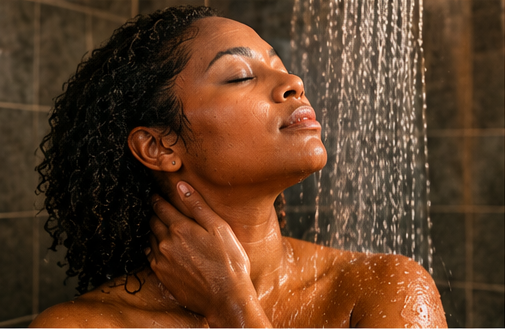
Maya had a question after her shower. She had done nothing particularly unusual. The day had been ordinary. The shower was familiar. She had used her Rejuvenation Self Care soap, applied a little body oil, and taken a few moments to settle into the quiet.
At some point, she had closed her eyes and mouth. The music seemed more present. But was she actually hearing more, or was she simply noticing what had been there all along?
It was a small question, the sort that can disappear as quickly as it arrives. Yet it opened up something worth examining: the relationship between our senses, our attention, and the meaning we give to ordinary experiences.
Attention: What enters the foreground?
We encounter more sensory information than we can consciously attend to at once. Attention helps prioritize some information while other information receives less of our awareness.
A familiar song can become background noise until a particular note catches our attention. The music has not necessarily changed. Our relationship to it has.
The useful question: Did the sensory input change, or did the way we attended to it change?
“The music has not necessarily changed. Your relationship to it has.”

When does a routine become a ritual?
A routine is a familiar sequence of actions. A ritual often includes something more “ceremonious”: a sense of significance, a recognizable sequence, symbolic meaning, or a particular way of approaching an activity.
Two people may perform the same sequence while experiencing it differently. One person washes and dresses as quickly as possible. Another uses the same actions to mark the transition from work to personal time.
Research suggests that particular rituals may support emotional regulation, goal preparation, and social connection. These effects vary; not every repeated action is a ritual, and not every ritual has the same outcome.
What research can—and cannot—tell us
Research gives us reasons to take ritual seriously as a subject of psychological inquiry. Studies suggest that particular rituals can influence reported emotions and perceived control under specific conditions.
But feeling calmer does not, by itself, establish that cortisol has decreased. Noticing a scent more strongly does not necessarily mean the sense of smell has become more sensitive. A meaningful experience does not prove that the same practice will affect everyone in the same way.
We can appreciate an experience without overstating what explains it.
Return to an ordinary moment
Choose a familiar activity—washing your hands, making tea, or applying body oil. Keep the task simple. For a moment, notice the experience rather than trying to change it.
- Notice the sensory details. What do you feel, hear, or smell?
- Notice your attention. What occupies your mind while you do the task?
- Notice the context. Are you rushing, transitioning, or pausing?
- Notice without judging. Did your experience change, or did it remain much the same?

Returning to the ordinary moment
Maya’s shower did not need to become an experiment for her to notice something interesting. She changed how she used her senses, noticed a difference, and became curious about what had happened.
Perhaps the value of an everyday ritual is not that it transforms an ordinary moment into something extraordinary. Perhaps it gives us an opportunity to encounter the ordinary moment with greater awareness.
Life is the master teacher. Ordinary experience gives us something to observe; research helps us examine what we observe; and reflection helps us decide what that experience means to us.
Research notes & further reading
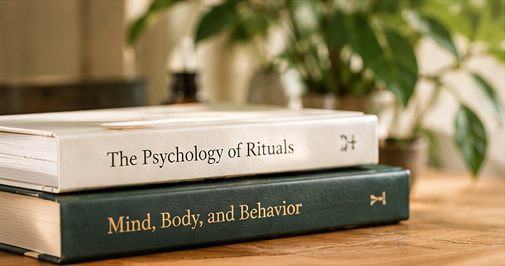
Hobson, N. M., Schroeder, J., Risen, J. L., Xygalatas, D., & Inzlicht, M. (2018). “The Psychology of Rituals: An Integrative Review and Process-Based Framework.” Personality and Social Psychology Review, 22(3), 260–284. Read the review.
Norton, M. I., & Gino, F. (2014). “Rituals Alleviate Grieving for Loved Ones, Lovers, and Lotteries.” Journal of Experimental Psychology: General, 143(1), 266–272. Read the study.
This article distinguishes research findings from interpretation and personal observation. It does not claim that ritual universally reduces stress, changes hormone levels, or improves physiological health.